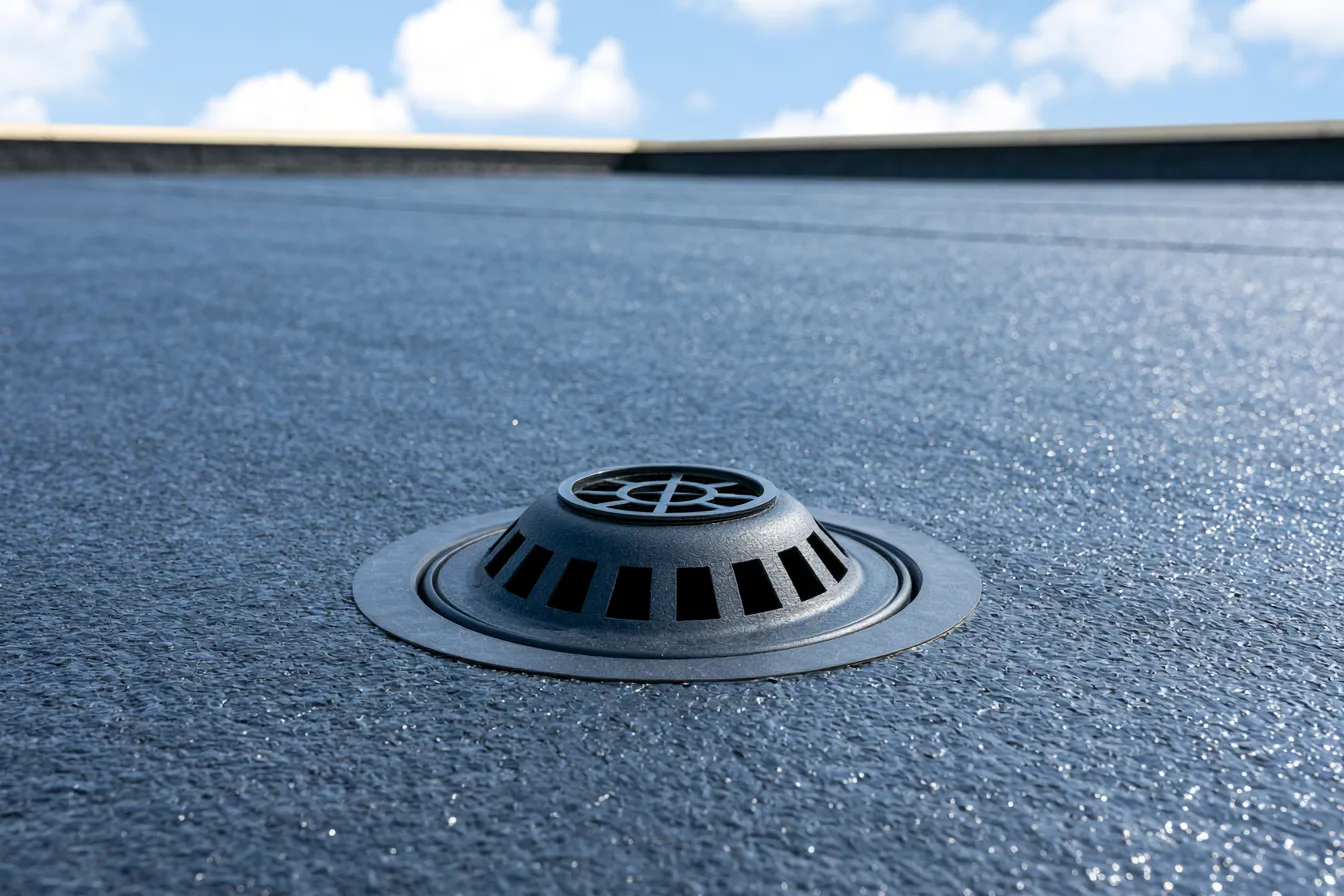
Commercial TPO Roofing in Edmond, OK
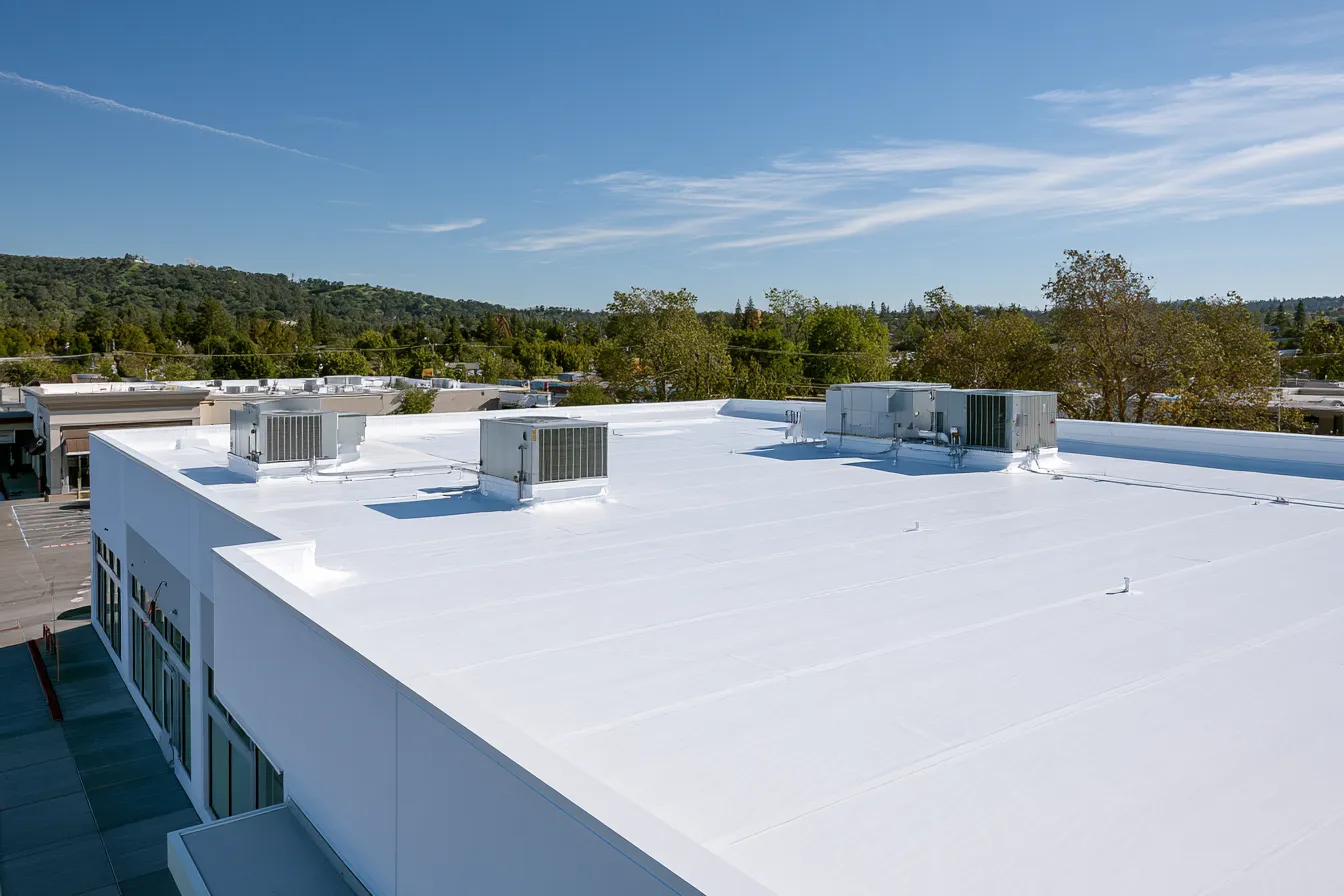
The bright white membrane on most of Edmond's newer retail strips and office boxes is TPO, a heat-welded single-ply sheet that seals a low-slope deck and throws the Oklahoma sun back off it. Commercial TPO roofing in Edmond, OK holds at its welded seams and the mil you put down.
- A dated read of the membrane and every weld
- Mil thickness sized to Oklahoma County hail
- Attachment and insulation named in writing
Call (405) 562-8471
What commercial TPO roofing gives an Edmond building
Walk the newer retail along Broadway Extension, the office boxes off Covell and Kelly, and the roof over your head is most likely TPO. It is a thermoplastic single-ply, meaning one light-colored plastic sheet, and its panels are joined by heat instead of adhesive, so the whole surface becomes a single sealed skin.
What makes or breaks it is the mil a roofer specs against the hail this county gets, and whether every weld truly fused, because a single-ply roof surrenders at a seam long before its open field wears through. A commercial roofer reads both, on record, before quoting a number.
What a TPO read puts on record
Reading an aging TPO roof, or specifying a new one, comes down to a short list an Edmond owner can follow line by line before anything is priced.
- 01The mil thickness, sized to the hail
- Sheet thickness is measured in mil, and TPO is usually stocked at forty-five, sixty, or eighty. Heavier means more resistance to a hailstone, a dropped tool, and a decade of sun, in that order. Because Oklahoma County has caught hail as large as four inches across, a roofer sets the mil to that history and to how often crews walk the roof for HVAC service, not to whatever the thinnest quote assumed.
- 02Every seam fused into one skin
- Seams are the whole game on a single-ply roof. Each panel edge is fused to the next with a hot-air weld that melts the two sheets into one, no tape and no adhesive involved. A careful roofer drags a probe down every finished weld, because a seam that looks closed but never truly bonded is exactly where the first heavy Oklahoma rain gets under the roof.
- 03Attached or fully adhered, chosen for the deck
- A TPO membrane is either mechanically attached, screwed to the deck with plates through the insulation, or fully adhered, glued down across the whole field. A fully adhered sheet lies flatter and rides out the wind uplift that crosses an open Oklahoma deck, while a mechanically attached one costs less on a sheltered roof, so a roofer names the method for your building and its exposure rather than defaulting to one.
- 04The insulation and R-value under the sheet
- A TPO roof is only the top layer; beneath it sits rigid insulation that carries the roof's R-value and, laid tapered, the slope that walks water to the drains. A roofer specs the insulation thickness and that layout alongside the membrane, because the sheet, the insulation, and the fastening are one assembly the wind and the energy code judge together.
- 05The white surface as an energy question
- The color is an energy decision, not just a weatherproofing one. A reflective roof runs cooler and can trim the cooling bill on a conditioned office or a medical suite that runs its units hard from May to September. Some energy codes now expect that reflectivity on a re-roof and some do not, so a roofer checks the version adopted here rather than guessing in either direction.
The trouble with hail on a flat roof is that you cannot see it from the ground; a bruise or a popped weld looks like an ordinary roof from the lot below. The storm damage page shows what a hailstorm actually leaves on a low-slope membrane, and the flat-roof systems guide sets TPO beside EPDM, PVC, and modified bitumen.
TPO questions from Edmond building owners
What an Edmond owner or facility manager weighs before welding a TPO membrane onto a low-slope roof.
Q1Why is TPO the common choice on Edmond's newer commercial buildings?
Q2What mil thickness should my TPO roof be?
Q3What is the difference between a mechanically attached and a fully adhered TPO roof?
Q4Does a white TPO roof actually cut cooling costs in Edmond?
Q5How does a TPO roof hold up to Oklahoma County hail?
Put your Edmond building's TPO roof on record
A TPO roof stands or falls on the quality of its welds, and most of Edmond's newer retail and offices are wearing one. Send yours to Edmond Roofing Co, and a local commercial roofer reads the membrane and every seam, puts the mil, the attachment, and the insulation in writing, and hands back a single scope and price that waits on your word.